get in touch


CADE is formed to promote dairy and agriculture sector and provide a platform to the enthusiasts who are willing to pursue their interest in these sectors.
Contact Us
- Call Us: +91 9671817307
- Email: info@cadedairyindia.com
- Regd. Office: B – 95, First Floor, Preet Vihar, Delhi-110092

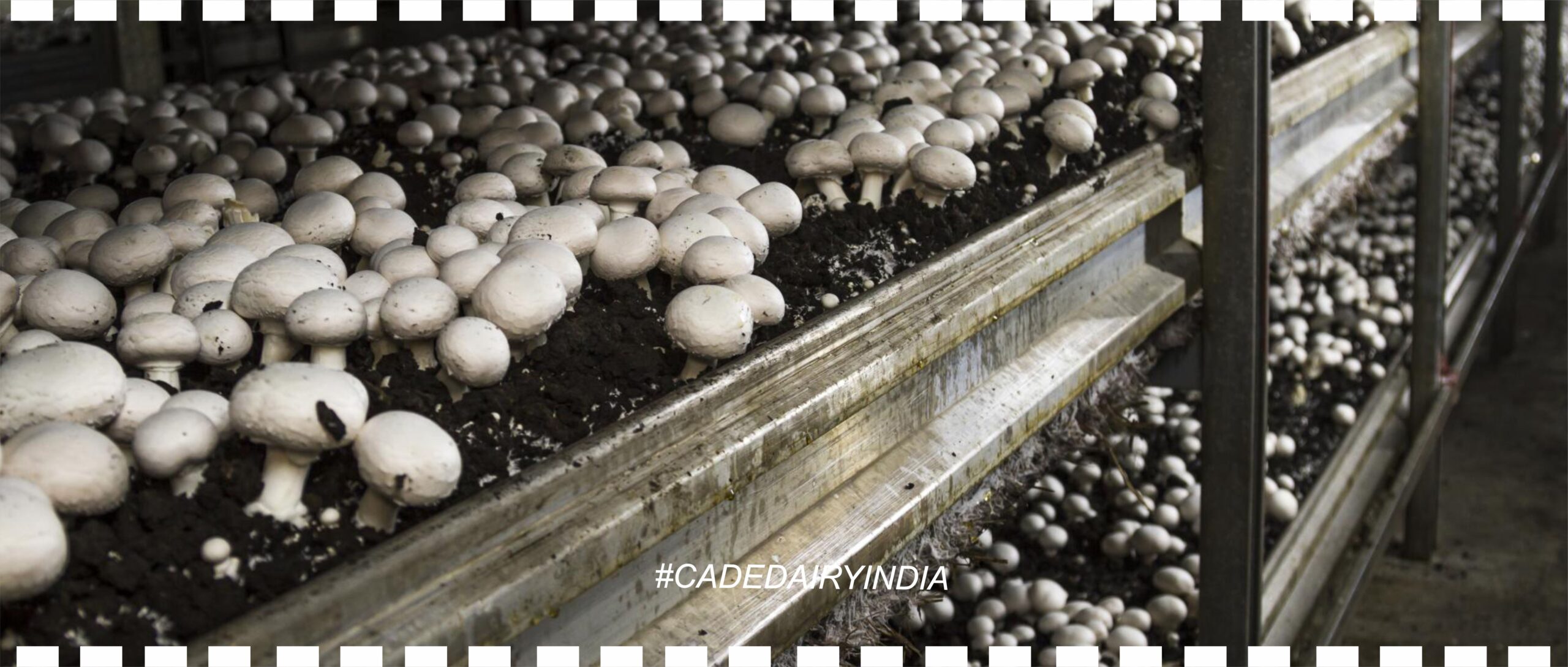
Mushroom Production
Mushroom production involves cultivating fungi on prepared substrates like straw or wood chips, requiring specific temperature (15–25°C), high humidity (70–80%), and low light. The process involves substrate preparation, sterilization, and inoculation with spawn, incubation, and harvesting. Common varieties include oyster, button, and shiitake, with production cycles taking 4–6 weeks for substrates and roughly two months for harvesting.
Mushrooms are the fruiting bodies of some members of a lower group of plants known as fungi. The fungi are characterized by the absence of chlorophyll and undifferentiated bodies except the spore bearing structures. The fruiting bodies, mushrooms, are fleshy spore bearing structures of the fungi. They contain numerous spores, functionally similar to seeds of the higher plants for propagation of fungi. Mushrooms appearing after rains in various shapes, sizes and colour have fascinated human being since time immemorial and were sure to draw the attention of humans even when they were living as hunters and gatherers. Even though, man started agriculture 10,000 years ago, the cultivation of mushrooms is a relatively new phenomenon and has picked up across the globe only in the last century that has witnessed newer innovations and applications. The Chinese were reportedly the first to artificially cultivate tropical and sub-tropical mushrooms thousands of years back but commercial production started in Europe with button mushrooms in caves during 16th and 17th centuries. The mushroom cultivation then made its way to the United States.
The economic importance of mushroom lies primarily in their use as food for human consumption. The exotic flavor, taste and fleshiness of mushroom have made it an important delicacy in human diet. Mushroom is considered to be a complete, healthy food and suitable for all age groups. Though, the nutritional value is determined by the type, stage of development and other environmental conditions, mushrooms are rich in proteins, dietary fiber, vitamins and minerals. They have insignificant lipid level and high proportion of polyunsaturated fatty acids resulting in low calorific value. The protein content, though varies greatly in different mushrooms, is usually high. Mushrooms are an excellent source of vitamins especially C and B (Folic acid, Riboflavin, Niacin and Thiamine) and minerals like potassium, sodium and phosphorus. It also contains other essential minerals like Cu, Zn and Mg in traces. Mushrooms are also known to have medicinal values as these have been shown to promote immune function, boost health, lower risk of cancer inhibiting tumour growth and support body’s detoxification mechanism. Mushroom, thus has great potential for the production as quality food.
The productivity of mushroom is higher than any other crop. Food, nutritional and medicinal values apart, mushroom growing can be an efficient means of waste disposal mainly agricultural wastes, since it can use the wastes as medium of growth and thus mushroom cultivation is considered as eco-friendly. Further, mushroom cultivation is highly labour intensive which can help gainful employment to unemployed youths in rural and semi-urban areas. The activity also requires comparatively less land area.
The potential of the mushroom crop is rated high on account of following reasons:-
o Availability of cheap and abundant raw material and labour.
o Appropriate technology for small and Hi-Tech growers.
o Demand–supply gap in the world trade of mushroom.
o Fall in production in many European countries due to high labour cost.o Proximity to Middle East, where market is growing.
o Domestic market is also growing which can absorb non-exportable surplus.
Types of Mushrooms
Naturally, mushrooms are found in diverse agro-climatic conditions ranging from arid to evergreen forest conditions. Worldwide more than 3000 mushrooms have been identified as edible, of which 200types are reported to have been produced under controlled conditions. However, not more than 60 varieties are being grown widely. There are about a dozen varieties which are cultivated on commercial scale. India is home to more than 300 varieties of mushrooms found in the wild.The major mushroom varieties of commercial importance are Button (Agaricus bisporus, A. bitorquis), Oyster–Dhingri (Pleurotus sp.), Paddy Straw (Volvariella sp.), Shiitake (Lentinula edodes), Milky Mushroom (Calocybe indica), Winter mushroom (Flammulina velutipes), Reishi (Ganoderma lucidum), Black Ear (Auricularia sp.) etc. Morel (Morchella esculanta) is seasonally harvested from the wild in north Himalayan states. In India, three types, namely button, oyster and straw mushroom are extensively cultivated on commercial scale.
Button: It is most popular variety both in the domestic and export market and ranks first in terms of production and consumption. It is grown both by seasonal growers in low cost structures as well in environment controlled units. Both the production systems viz., seasonal and controlled environment growing is in vogue throughout the country. The button mushroom is grown throughout the country, with Punjab, Haryana, UP, Uttrakhand, Himachal and Tamilnadu contributing significantly to the national production.
Oyster: This mushroom, commonly called Dhingri, is suitable for the temperate, sub-tropical and tropical regions of our country. The regions suitable for button mushroom are equally suitable for this mushroom. This type of mushroom is generally dried and exported. This has tremendous potential as it can be grown on a variety of substrates under varied conditions. The production technology is relatively simple with low production costs. India produces annually about 10000 tons of this mushroom. The Oyster is widely cultivated in states of Orissa, Andhra, Karnataka, Maharashtra, Madhya Pradesh, West Bengal and North-Eastern states. Punjab and Tamilnadu are the leading producers of this type on commercial scale.
Paddy Straw: This variety is suitable for sub-tropical regions of the country. There are more than 19 edible varieties of this species, of which cultivation methods of only three species, have been developed. This mushroom is very popular for its taste and flavor in the Eastern and Southern India, especially in the coastal region and extensively cultivated in Orissa. It can be grown in temperate regions by maintaining temperature conditions. Its potential remains under exploited despite abundant availability of paddy straw and highly suited environmental conditions.
Specialty Mushrooms: This group includes mushroom of various types which are less common in a particular region or country. On this count, Oyster, Paddy Straw, Shiitake, Black Ear, White Milky, Winter Mushrooms fall under this category. The demand for these mushrooms, in recent years, has shown an upward tendon account of its novelty and medicinal value, fetching high prices in the global market. The Indian sub-continent is endowed with varied agro-climatic conditions for growing these mushrooms.
Medicinal Mushrooms: Medicinal mushrooms have an established history of use in the traditional oriental medicine. Many mushrooms especially belonging to the genus Auricularia, Flammulina, Ganoderma, Grifola, Lentinula, Tremella etc. have been found to possess medicinal properties. Ganoderma lucidum is the most popular mushroom commercially used and traded in the world.
India, bestowed with varied agro-climatic conditions, has tremendous potential for production of a variety of commercial edible and medicinal mushrooms. There is increasing demand for quality products both in domestic and export markets. Country’s domestic market will expand on account of changing food habits, rising income and rapid urbanization. The world market has shown a significant growth in recent years making it more attractive for Indian exports.
India with abundance of agricultural wastes, relatively cheap labour can thus be a potential mushroom producer in the world.
Key Steps in Mushroom Production
Substrate Preparation: Agriculture waste such as paddy straw, sugarcane bagasse, or wood chips are used as a growing medium. The substrate is soaked, pasteurized to eliminate contaminants, and then cooled.
Inoculation (Spawning): Mushroom seeds (spawn) are mixed into the prepared substrate.
Incubation: The inoculated substrate is stored in dark, cool, or humid conditions to allow the mycelium to spread through the substrate.
Fruiting & Harvesting: Once the substrate is fully colonized, environmental conditions are adjusted (light, temperature, moisture) to induce mushroom growth (pinning). Harvesting usually occurs over 2–3 weeks.
Production Environment & Requirements
Humidity & Temp: High humidity (70–80%) is essential, and temperature varies by species, generally around for oyster mushrooms.
Substrate: Roughly 2.2 kg of dry substrate is needed for 1 kg of mushroom production.
Equipment: Necessary items include sterilization equipment (like autoclaves), mushroom spawn, polythene bags or beds, and humidity control devices.
Key Considerations
Varieties: Oyster mushrooms are considered easier and better suited for smaller projects, while button mushrooms require more complex compost management.
Small Scale vs. Large Scale: Mushrooms can be grown at home using simple, low-cost methods, or commercially, which may involve higher investments for sterilization and environmental control.
Common Issues: Contamination is a major concern, making sterilization of the substrate and environment crucial.